The problem with getting serious about wine is that the research never stops. Every producer you discover leads to three more. Every region has a hundred estates worth understanding. You can spend an hour reading about a single domaine and still feel like you've only scratched the surface — and then forget half of it by the next morning.
I wanted a way to institutionalize that research. Not just bookmarks or scattered notes, but something that captured a producer at depth: who founded it, who runs it now, how they farm, how they cellar, what they make, what it costs, and whether it's worth acquiring. A dossier, essentially. The kind of thing a Master of Wine might keep on file.
So I built one. And then I let AI fill it in.
What it does
Vintner Intelligence is a producer research tool that takes a winery name and generates a complete profile in a single pass. The output is structured across several sections:
- Estate overview — region, founding date, first commercial vintage
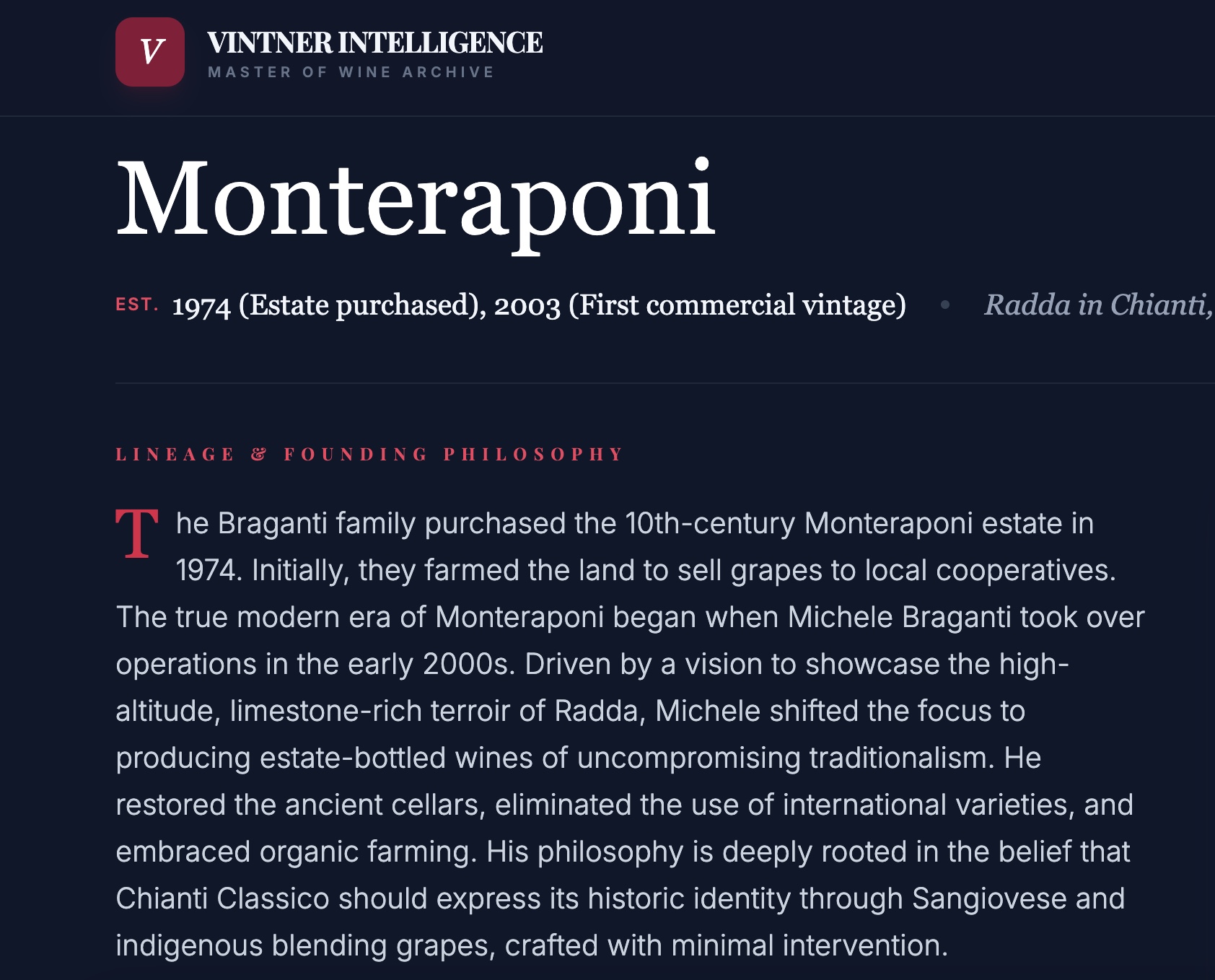
- Lineage & founding philosophy — the family history, how the estate came to be, and the vision that shaped it
- Current winemaker — who's at the helm now and what they've brought to the estate
- Cellar strategy — farming approach, fermentation, oak usage, aging regime
- Age-worthy vintages — the years worth cellaring and why
- Sommelier recap — a tight, eloquent summary of what the estate represents
- Terroir & estate size — soil, elevation, vineyard composition
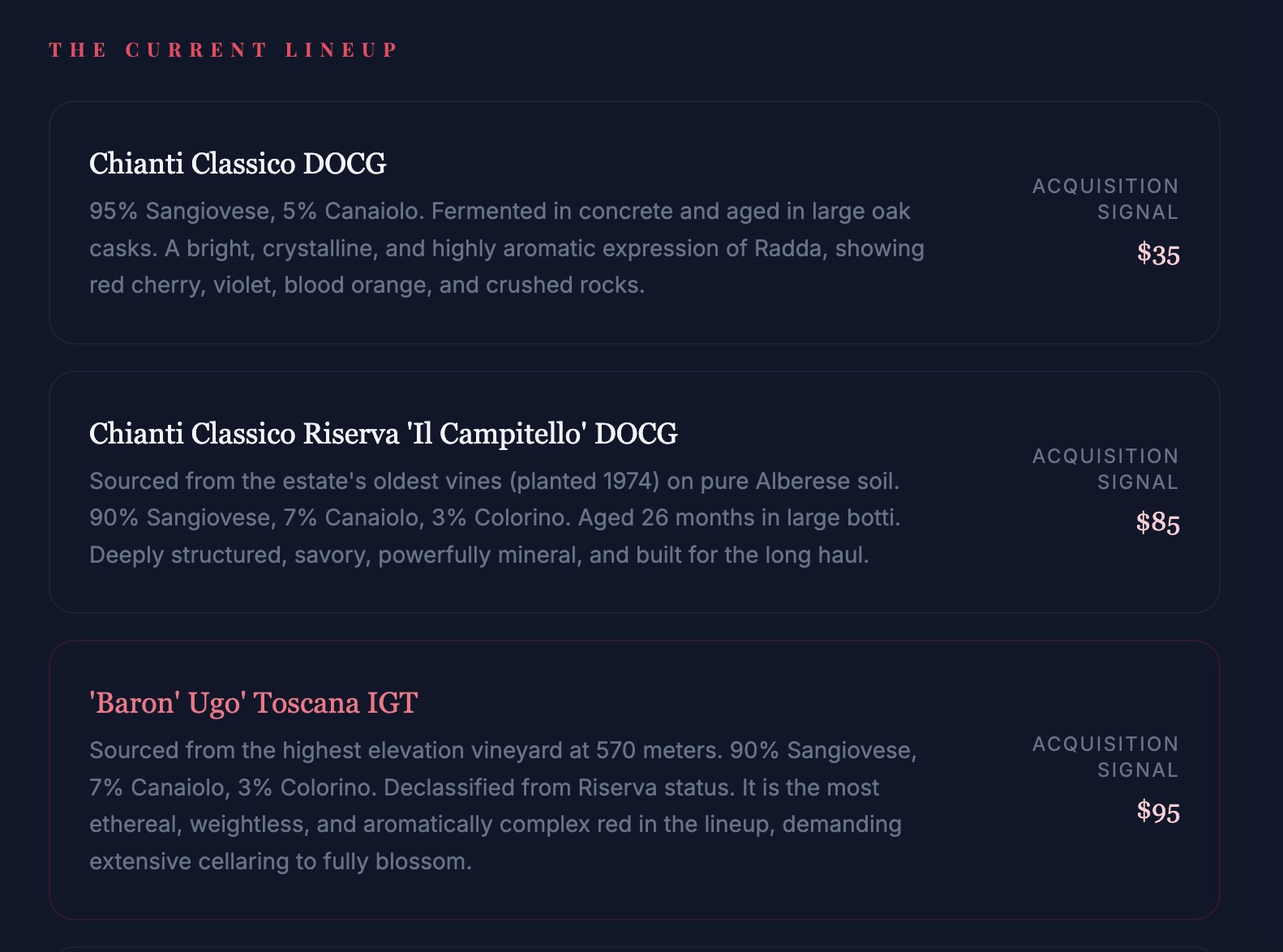
- The current lineup — every major wine with blend information, tasting notes, and an acquisition price signal
That last section is the one I use most. Knowing that the Monteraponi Chianti Classico DOCG is a $35 entry point into a serious estate, while the Baron Ugo IGT at $95 is the ethereal ceiling of the lineup — that's actionable intelligence when you're deciding where to spend.
How I built it
This was built entirely in Google AI Studio — and it was a true one-shot build. I described exactly what I wanted: the sections, the structure, the depth of content, the aesthetic. The app came back with a working interface and the ability to generate real producer profiles from scratch. It's containerized and hosted on Google Cloud Run — meaning it's a live, working tool, not just a prototype.
No data entry. No pre-loaded database. You type a producer name, and the AI sources and structures everything — history, philosophy, winemaking approach, bottle lineup, pricing — into a formatted dossier.
What makes it work
The content quality is what surprised me most. The Monteraponi profile it generated was accurate in the ways that matter — the Braganti family history, Michele's takeover in the early 2000s, the shift to estate-bottled wines, the focus on indigenous varieties, the high-altitude limestone terroir of Radda. These aren't hallucinated generalities. They reflect real, specific knowledge about a small Chianti Classico producer that most people have never heard of.
The design also punches above its weight. The dark navy palette, the serif typography, the "Acquisition Signal" pricing label, the editorial drop cap on the lineage section — it doesn't look like a utility app. It looks like something a serious collector would actually want to use.
The honest limitation
Because the content is AI-generated from public sources, it reflects what's known and indexed — which for most major producers is substantial, but for very small or obscure estates can be thin. Pricing signals are estimates rather than current market data. And like any AI-generated research, it rewards verification rather than blind trust.
For how I use it — building familiarity with producers before a trip, deciding what to seek out, understanding a lineup before walking into a retailer — those caveats don't really matter. It gives me a running start that would otherwise take hours of reading.
What I'd build next
The natural evolution is persistence — being able to save profiles, annotate them with your own notes, and build a personal archive of producers you've researched or tracked over time. Right now each session is stateless; the knowledge lives in the generation, not in a database you own. That's the version I'd want to live in long-term.
There's also an obvious pairing with the Burgundy Map project: imagine clicking a producer in a village and pulling a full Vintner Intelligence dossier inline. That connection is still theoretical, but it's where this is heading.
Built with Google AI Studio · Hosted on Google Cloud Run · Early 2025