There's a problem that every Burgundy beginner runs into eventually. You're reading about wines, talking to people who know more than you, maybe sitting across from a sommelier who's rattling off villages and producers — and you're nodding along while quietly losing the thread. The names are French, the geography is layered, and by the time you get home you've already forgotten half of what you wanted to remember.
That was me about six months ago, deep into preparing for a trip to Burgundy and realizing that a notes app wasn't going to cut it. I needed to see the region. And I needed somewhere to put the wines I was learning about before they evaporated from my memory.
So I built something.
What it does
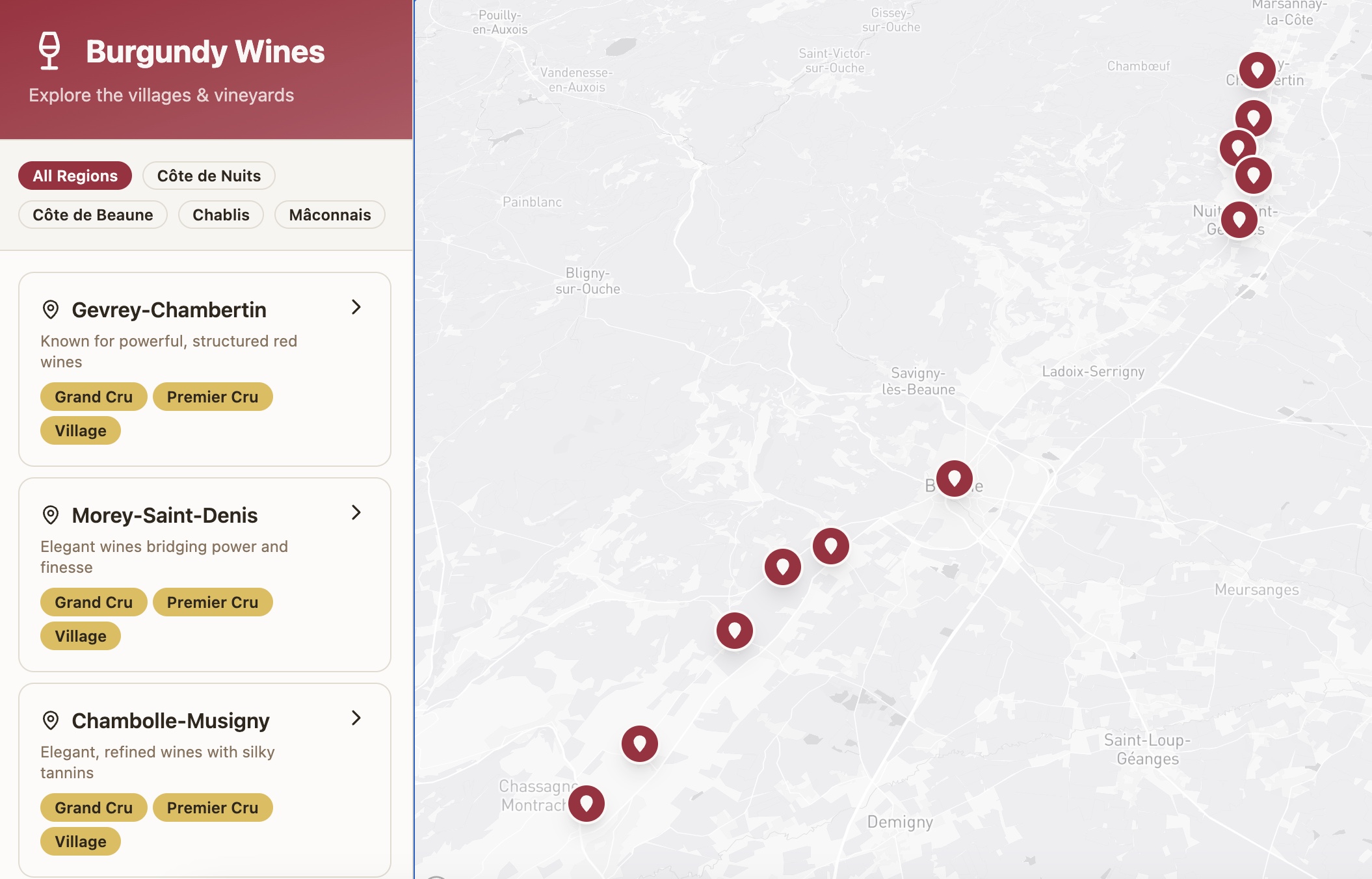
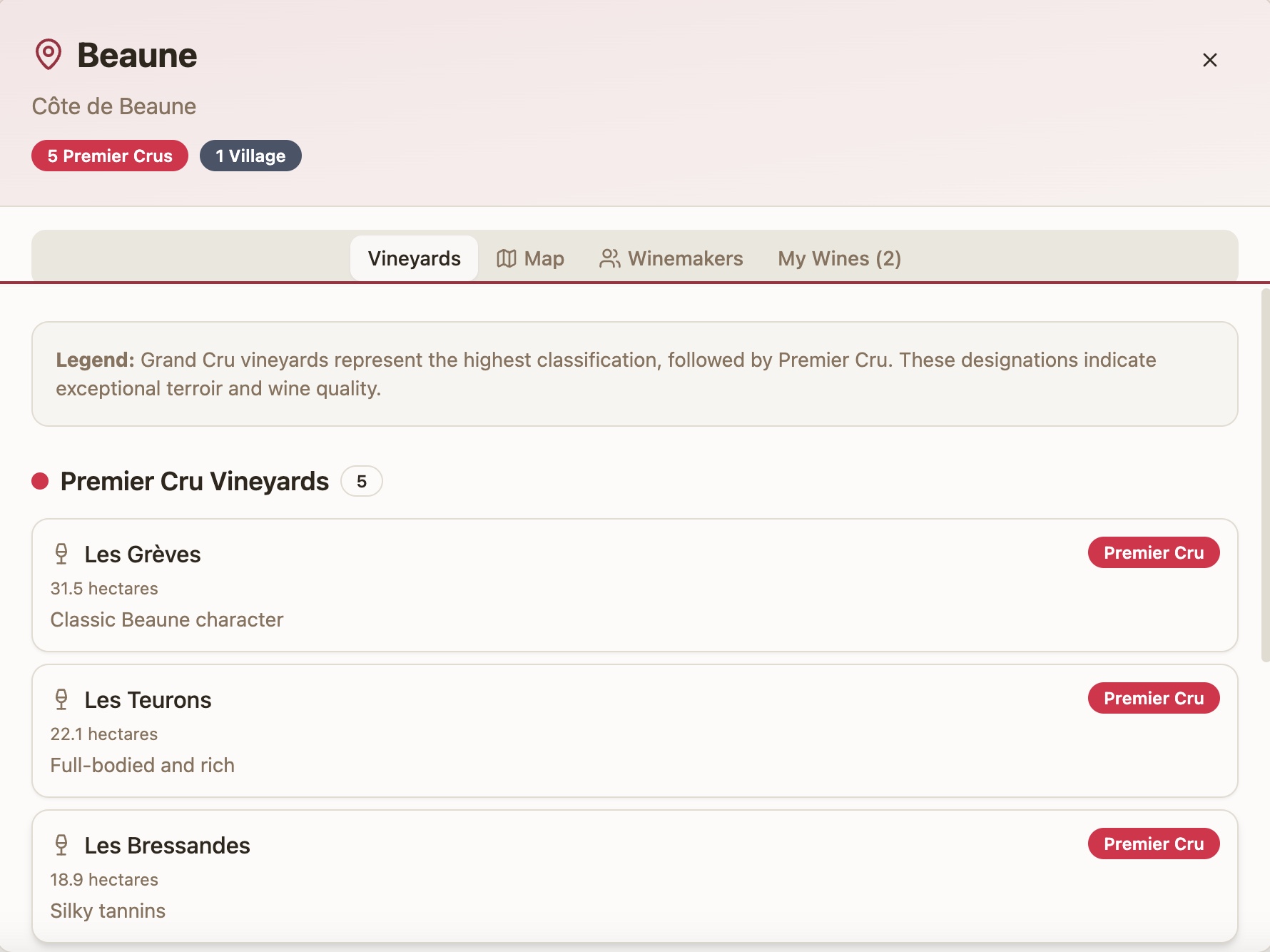
The app is a split-view interface — a map of Burgundy on one side, a scrollable list of villages on the other. You can filter by region (Côte de Nuits, Côte de Beaune, Chablis, Mâconnais) and click into any village to see its classification breakdown: Grand Crus, Premier Crus, and Village-level wines, each with acreage and a brief character note.
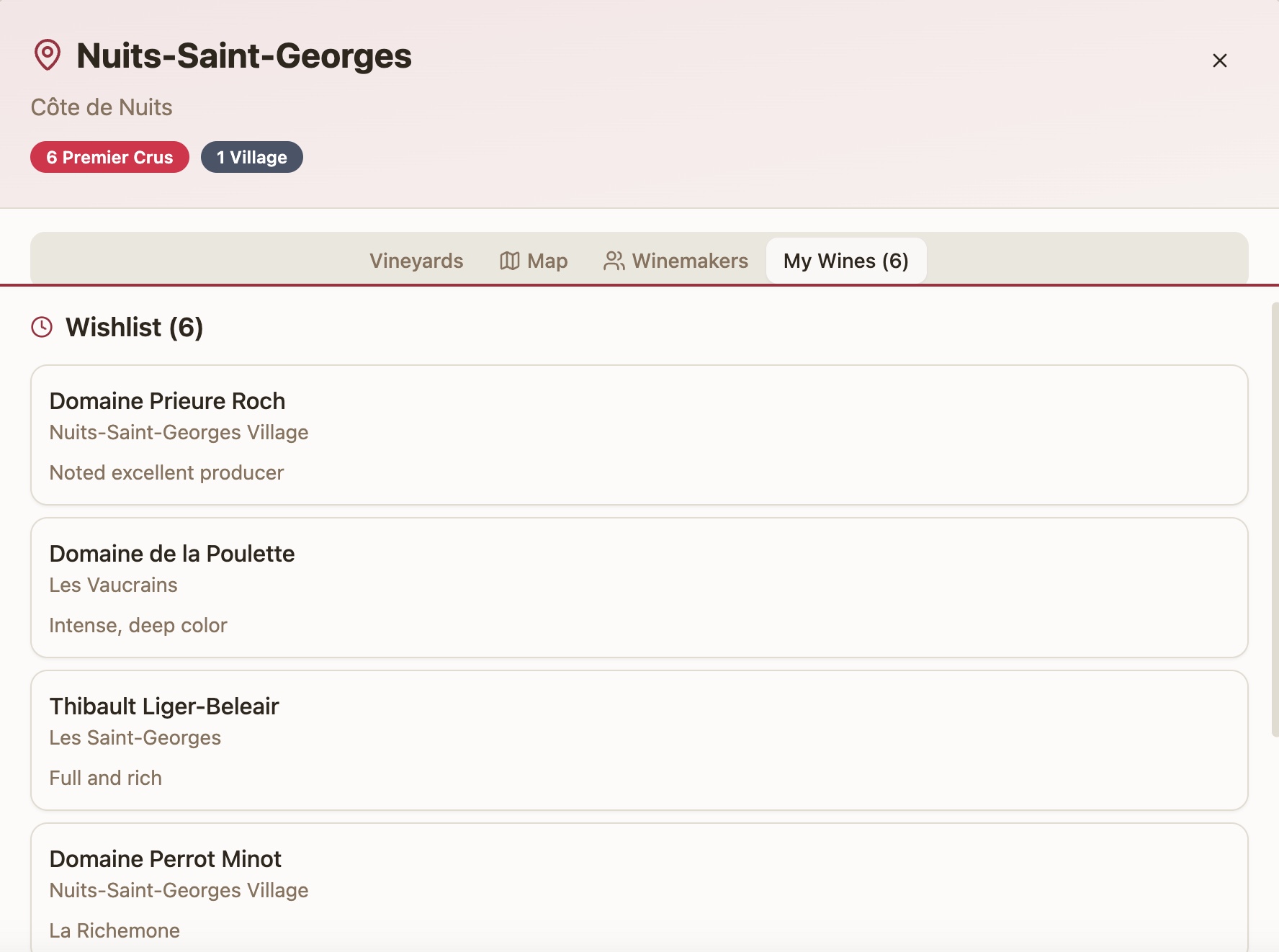
The part I use most is the personal wine tracker. Inside each village, there's a "My Wines" tab where I can log bottles I've had or want to try — tagged to a specific vineyard and producer. It became a running wishlist organized by geography, which is exactly what I needed.
How I built it
I built this entirely in Lovable — no code written by hand. My only job was describing what I wanted and iterating on the result. For someone with no development background, the experience was genuinely surprising. The map integration, the tabbed village detail view, the classification tagging — things I would have assumed were weeks of work came together in a weekend of prompting.
What worked
The core concept held up. Having the map and the list side by side made the geography click for me in a way that reading alone hadn't. Burgundy is a long, narrow corridor — seeing the villages strung out north to south, understanding that Gevrey-Chambertin sits at the top of the Côte de Nuits while Chassagne-Montrachet anchors the bottom of the Côte de Beaune — that spatial understanding is harder to get from a book.
The wine tracker also became genuinely useful. By the time I had my trip itinerary set, I had a village-by-village wishlist that I'd built up over months of reading and conversations. That's the kind of thing that's worth having.
What didn't
Two things I'd do differently.
The vineyard-level maps within each village were the feature I most wanted and the one that fell apart. Getting precise parcel boundaries rendered accurately on a map is a hard technical problem — the data isn't clean, the coordinates require sourcing and formatting, and Lovable hit a wall. The village pins on the main map work fine, but if you click into Chambolle-Musigny hoping to see Les Amoureuses plotted against Musigny, you won't find it. That's still the version I want to build someday.
The system-generated winery and vineyard notes were the other miss. Lovable populated descriptions for each producer and vineyard automatically — things like "Full and rich" or "Classic Beaune character" — which looked fine in the UI but were too thin to be useful. They're placeholders dressed as content. What I actually want there is my own notes: what I've tasted, what someone told me, what I read in a grower profile. The infrastructure exists; I just need to fill it with something real.
What I learned
This was my first project built with an AI tool, and the main thing it taught me was that the constraint isn't the technology — it's the clarity of the idea. Lovable could build almost anything I described precisely enough. The vineyard maps failed not because the tool couldn't handle maps, but because I couldn't fully specify what I needed and the underlying data problem was harder than I'd accounted for.
The other thing: shipping something imperfect is better than waiting for perfect. I used this app throughout my Burgundy research and it made a real difference. The version I imagined at the start would have taken longer to build and sat unused while I waited to get it right.
Built with Lovable · November 2024